Copyright
is for the living.

As a publisher, I have an enormous interest in copyright because that is ultimately what I’m selling. I’m selling the copyright to manuscripts that have been sub-leased to me by authors. But I also think that the way that copyright operates in the world today is verging on insane, and it’s one of the many leftovers from the pre-digital era that would best be completely re-thought by some global forum, along with the internet, the environment and indeed the future of the human race. I wrote a song called Copyright several years ago which addressed this topic and has as it’s kicker the line “Copyright is for the living, royalties are not for the dead.” (Find it on Spotify, Apple Music and other platforms). And while there are exceptions and extenuating circumstances, I think that’s basically right.
Copyright law was first introduced in England in the early 18th century, the year 1719 to be precise, to protect the rights of authors who had produced a bestseller only to find that the shop next door had reprinted it and selling it perfectly legally. The purpose of the copyright law, again to quote the song, was “meant as encouragement to give authors income supplement, to convince them to do another one.” My song is a remake of a John Coltrane number, partly for tongue-in-cheek reasons. I have not yet been sued for releasing it.

In the process of publishing books, I have on many occasions come across copyright issues. In the early years of Earnshaw Books we did many reprints of books that had arguably, or not, fallen out of print, and in some cases we looked for the descendants of the original authors, in all cases long-dead. I was concerned at the start about the consequences of publishing these books without permission of the families, but when we did manage to make contact or were contacted by the descendants, they, in all cases, expressed joy and thankfulness that the works of their great-grandfather had been granted another run in the sun.
We also contacted the descendants of Sapajou when we published the great cartoonist’s collected works, the great nephew of Carl Crow, Dennis Crow on Crow’s classics 400 million Customers and Foreign Devils, and the descendants of Ivon Donnelly, author of Chinese Junks. Full support from all.
The only exception to this is the wide and eccentric family of Edmund Backhouse. When we published his China memoirs, Decadance Manchoue, which are hilariously homo-erotic and delightfully sensational, we reached out to several of the descendants and in a couple of cases there was pushback from what I imagine to be the parlors of upper-class mansions across southern England. But there were also many Backhouse descendants very happy to see the works of their eccentric forebear finally emerge into the light of day from the Bodlian Library, where it had lying in obscurity gathering dust. Anyway, we published it, with Derek Sandhaus doing the bulk of the editing and liaison work, and no Backhouseian lawsuit emerged. Edmund was long dead, and my guess is that he would have relished having his work being formally published, as well as been disappointed that the world had changed and his flowery celebration of what Oscar Wilde (who Backhouse claimed to have bedded) described as “the love that dare not speak its name” no longer shocked to the same degree. But it still shocks, honest!
I regularly receive, as maybe do you, e-mails from various websites in Russia and some other eastern European countries, offering books we have published for nothing in PDF or e-book form. This is of course depressing, because we worked hard on creating them. But you can also say that emulation is a mark of success, and if somebody thinks that our books are worth pirating, then maybe it proves that they have some value and market traction. With all of our books published by Earnshaw Books, the contract that we sign always makes it clear that the ultimate copyright lies with the author, not with us the publisher. It’s usually for a term of 10 years, extendable, and that is fair because, in almost all cases, our authors are still alive. And long may they be so. And we also would and have paid royalties to relatives left behind after the death of an author.
But in my heart of hearts, I’m not entirely sure what right the children or grandchildren of an author have to the proceeds of such a book. In the wider world, copyright is now taken to ridiculous extremes by Disney and other major IP holders, who extend endlessly by various methods the copyright on various works that should long ago have fallen into the public domain. There is also the question of the copyright on images and text references, or excerpts, that are used in books, for example the lyrics of the song Happy Birthday and other songs, or photographs taken in Shanghai or San Francisco in the 1930s. My instinct is to push the envelope on this because it just seems silly for copyright owners to effectively hobble creativity by being litigious over the use of such materials long after the death of their creators. There is a similar or related situation with digital samples in the music world, and in that case the creators are usually still alive. In the case of music, I am sure ultimately digital will win out over out-dated copyright concepts. And for books? Some changes are long overdue too.
Earnshaw Books Reprints
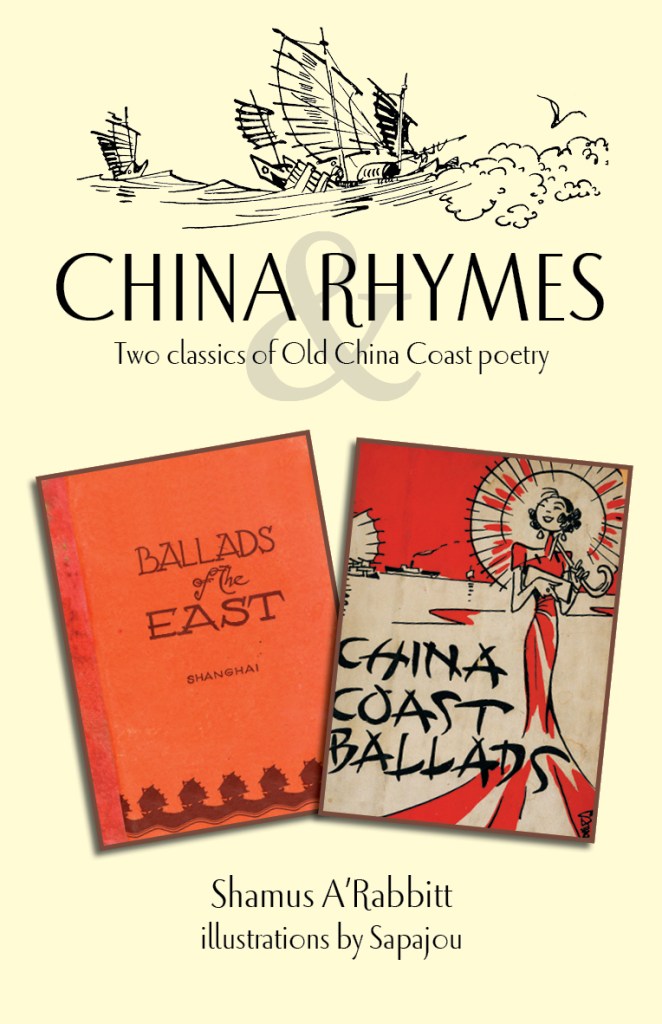
| Shamus A’Rabbitt (Illustrations by Sapajou) China Rhymes |
| The poet laureate of the China Treaty Ports, Shamus A’Rabbitt caused a sensation in the 1930s with his “Ballads” books, which mocked the world of foreigners in the Orient. His poetic portrayals were sharp, accurate and hilarious. With bouncy, limerickesque rhythms, razor-sharp satirical wit and a healthy distaste for hypocrisy and pretension, Shamus A’Rabbitt’s work today gives the reader a perfect whirlwind tour of the world of Old China. |

| Carl Crow 400 Million Customers |
| Probably the best-selling book on doing in business in China ever – and undoubtedly the best ever written – Carl Crow’s 400 Million Customers is amusing and informed. First published in 1937, 400 Million Customers is the distillation of the experiences of one of the most successful foreign businessmen ever to wash up on the China coast. Crow brilliantly explains the eternal truths about doing business in the Middle Kingdom. |

| Ivon A. Donnelly Chinese Junks |
| The sailing junk was an amazing vessel. Ivon A. Donnelly immortalized these lost treasures in this book from 1924, with a pen and sketchpad and with words that betray his passion for the ancient watercraft of China. Vivid and graceful, grotesque and gay, junks were supremely honed for their particular work. Though time and new technology took their toll and the junk is today all but extinct, their spirit lives on through this delightful collection. |
Foreign Devils
classic tales and memoirs that live on

It’s now 16 years since Earnshaw Books was founded, and the first book which triggered the whole enterprise was a volume with the delightful title Foreign Devils in the Flowery Kingdom written by Carl Crow. I had been fascinated by the memoirs of foreigners living in China since I first arrived in Greater China in 1973. My reading, in Hong Kong in those days and for long after, always included memoirs of foreigners who had lived, traveled or had adventures in China. And by the mid-noughties, when I had set up a company in Shanghai which had design and printing capabilities, I decided to use it as a platform to give some of these old books, then resting nowhere but the dusty shelves of forgotten libraries, another run in the sun.
The first book we chose was Foreign Devils because Carl Crow was one of the best writers from the the 1930s, and also one of the most active foreigners in the great enterprise that was linking China with the outside world in that pre-war pre-revolution era. He had lived in China for decades and was instrumental in setting up the advertising industry in the country, using Shanghai as the base. He wrote several books before and after his departure when the Japanese arrived in 1940, but the best two are Foreign Devils in the Flowery Kingdom and 400 Million Customers. What was remarkable about Crow’s books, and indeed the many other books that we republished back then, was the high degree of parallels and similarity between the experiences of these foreigners in China, in the late 19th century or early 20th century, and the experiences of foreigners in today’s China. I was encouraged to republish these books by the reaction I had to the attitudes of many foreigners who seemed to believe they were the pioneers and that their experiences were unique. In fact, many foreigners had trodden these paths before, albeit in a different era.
China has of course changed immensely in the past hundred years or more, but there are many aspects of Chinese culture and society which remain unchanged and, in a contrarian way, I always tend to emphasize the continuity rather than the changes. And these memoirs are a reminder and reflection of that continuity, as well as a fascinating first-person window into the China of the past. History books written by people today always lack, to some extent or another, authenticity, because they weren’t there. And while a writer such as Carl Crow had a deficiency in terms of the wider view provided by hindsight, the immediacy in terms of richness and depth in descriptions he and others provide, completely offsets that minor shortfall, particularly because from our perspective of today, we know the context in a way that he could never do.
These books are still available, both on our website as digital downloads or from Amazon as printed tomes for those beyond the China world. If you are in the China world, however, and would like a paper copy, drop us a line.
other Carl Crow Classics

| 400 Million Customers |
| First published in 1937, 400 Million Customers is the distillation of the experiences of one of the most successful foreign businessmen ever to wash up on the China coast. Crow brilliantly explains the eternal truths about doing business in the Middle Kingdom. |

| The Long Road Back to China |
| In 1939 Carl Crow travelled up the Burma Road from Rangoon to the wartime Chinese capital of Chongqing. The road was China’s perilous but vital 717-mile lifeline to the outside world. In Chongqing, Crow describes what was at that point the most heavily bombed city on Earth, observes the daily struggle of the Chinese people under Japanese bombardment, and interviews the most senior Chinese government members. |
Writing A Book
where to start and how to do it

The old joke about book writing features two people at a party and one says to the other, “I am writing a book,” and the other person says, “Neither am I.”
This exchange succinctly reflects the situation with more than 90% of people writing books. It is very easy to say I am writing a book and it is also easy to play around with the idea, writing snippets, trying out different formats. The really really difficult part is finishing the first draft. The main reason is totally psychological. Up to the point of finishing a first draft, it is all about anticipation. There is no need to prove yourself, and there is no fear of failure, because it is an ongoing project with no fixed deadline. But once the first draft is completed, then it raises the question of whether or not it is good enough. It raises the question of what will other people think of it? This has huge implications for one’s ego. Hence the joke.
I have written quite a few books and I have edited hundreds, and I have probably reviewed or given consideration to over 1000 manuscripts, maybe more. I nave no Idea. My thoughts on how to write a book are based on this experience. That doesn’t mean that I am right, or that these rules are absolutely essential for the writing of a book. There are no absolute rules. But there are ways of approaching the creation of a book which are more likely to be effective than others.
The first step is to decide on an idea, and then to flesh it out in an arc of let’s say 10 chapters. Of course, the idea can be divided into eight chapters or 12 chapters or more or less depending upon the topic and the materials. But let’s start with 10 as a safe number. This approach, by the way, works for both fiction and non-fiction. There are authors who claim that they start writing a book without any clear idea of where it is going or what will happen to the protagonists. I am talking here of fiction. But they are either supernatural beings or else they are not being entirely truthful. A degree of organization is required in order to produce a book. To get ideas started, it is entirely possible to just throw yourself into a section, either of a story or of a discussion for nonfiction, and then use that snippet as the basis for creating a structure. The structure can be in your head or it can be written down, but my advice would be to write it down and try to be as clear as possible in the construction of the structure.

What results is a Table Of Contents. And the first thing to consider is, does the structure work? Is it interesting? Is it likely to keep a reader’s interest alive through the whole arc, from beginning to end? Are there any parts which are likely to be boring? All the elements should be in the right order once the structure has been fixed, although of course it can be altered again at any time in the future.
The next step is to fill it out with sub points. My advice would be to aim for 10 bullet points under each of the 10 chapter headings. You then have 10×10, 100 bullet points that make up the manuscript (and again this can work for both fiction and nonfiction, although fiction may be less appropriate for this form of organization). Assume that each bullet point when actually written will be around 500 words. 500×100 = 50,000, which is about the right number of words for most books today.
The order in which these parts are written is entirely irrelevant. You can write the first section of chapter one first or you can write the eighth section of chapter 7 first, it really doesn’t matter. It also doesn’t matter how perfect the words are in any of the sections you write. One of the big errors that many writers make, in my opinion, is that they spend too much time on the self-editing in the midst of the creation flow. This becomes a barrier to the completion of the overall structure and the completed first draft. It is better to just charge on regardless and complete each of the sections and the whole first draft, in the knowledge that the writing and the content is not necessarily perfect, and that much will need to change. The reason for this is simply that until there is a first draft, there is nothing. The book does not exist. All of the work that has been put into creating something up to the completion of the first draft is wasted unless that last step is taken. It is as if nothing had ever happened. No work had ever taken place.

As soon as we have an absolutely awful first draft of a manuscript, what next? The first step is to go through the manuscript and look at it purely from a structural perspective. Are all the elements in the correct places? Is there too much or too little on any of the individual sections? Should the basic Table of Contents be changed in any way? If so, now is the time to do it. The second time you go through the manuscript is to start doing a line edit, that is a detailed review of each word and phrase and sentence, in order to improve the overall writing and to consider changes including movement of paragraphs, cutting stuff or leaving notes to yourself as to what needs to be added. Another important element to consider here is that in this phase, it is my advice that you don’t spend a lot of time on adding extra material. Simply make notes to yourself as to what needs to be added in order to take the manuscript to a more perfect second draft.
So you have now written the first draft, and you have been through the manuscript twice, and at this point you have a couple of choices. My advice would be to now pass the manuscript to somebody else for comments and review. This needs to be somebody who is a friend probably, because why would anybody put the time and effort into reading the manuscript unless they are getting money for it, unless they were your friend. But you need to choose the friend carefully. Someone who is simply going to say “it’s wonderful, it’s a great book, great piece of writing”—this is useless, it has no value to you. What you’re looking for is feedback from someone who will be honest and as detailed as possible. When you get such feedback, the important thing is to basically always surrender to it. Of course, all opinions in this area are subjective, but there are two reasons why comments from other reviewers are probably to be implemented. The first is that they have a huge advantage over the writer and that is objectivity. The lack of objectivity is the biggest drawback that the writer faces in the production of a finished manuscript, and the only way of dealing with it is to get outside advice.
The other advantage that a second reader has over the author is a fresh eye, both with regard to the structure and the specific words in sentences. Writing is an intensely individual and personal experience, and it’s so easy to get lost in the middle of the process and lose a sense of what the overall purpose is, or whether or not the overall intended effect has been achieved. So while it can be painful, in almost all circumstances it is best to accept the advice of people who provide it. Always remember that it is extremely difficult for a friend to provide negative feedback to someone they know. It is so easy to say it’s great, I loved it. But it is really difficult to say I thought this was not so good or I would suggest that you change that. That form of criticism, no matter how it is couched, however softly, is difficult and needs to be taken into account by the author. The reader has really taken a leap in terms of preserving the relationship that they have with the author and the words have a much greater value as a result of that.
So there we are. Now begin your book. Start with a blank screen and type the word ‘The.’
Got something you think might be worth submitting?
info@earnshawbooks.com
You must be logged in to post a comment.